Capturing Fleeting Light in a City That Never Stands Still

A Creative Journey Born in Live Music Venues

I first picked up a camera when I was in high school.
At the time, music was at the center of my life. Night after night, I found myself in live music venues, captivated by the musicians on stage. The intensity of their performances left a lasting impression on me, and before long I began to feel an urge to create something of my own.
The trouble was, I had no talent for music whatsoever.
So I started looking for another way to express myself. I happened to own a camera, and photography seemed like a natural place to begin. Before I knew it, I was photographing the very performances that had inspired me.
Most of those venues were tucked away in neighborhoods like Shibuya, Shinjuku, and Koenji. After the shows, as musicians and audiences drifted into the streets, I'd continue photographing them on the walk to late-night gatherings. Without realizing it, my attention had begun to shift from the stage to the city itself.
Joining the photography club at university only deepened that fascination. Street photography came naturally, but to me there was never a clear boundary between photographing a live performance and photographing everyday life. Both demanded the same instinct: to recognize a fleeting moment before it disappeared.
Eventually, I found that university photography wasn't enough. Wanting to devote myself fully to the craft, I left university and enrolled in a photography school to pursue the craft more seriously.

The Opportunity That Opened a New World

My first solo exhibition was held in Shinjuku in 1994. Titled Portrait, it featured high-contrast black-and-white portraits illuminated with flash.
The exhibition was met with a disappointing response.
As discouraging as that was, it forced me to reconsider what kind of photographs I truly wanted to make.
The following year, I produced a new body of work titled NIGHT CRAWLER: Wandering Through a Fictional City. I abandoned flash altogether, choosing instead to work with the city's existing light. The streets, the darkness, and the glow of the night became part of the photographs themselves. The series was selected for my school's graduation exhibition, and I still remember the quiet sense of encouragement that recognition gave me.
Soon afterwards, the project received a photography award. An editor at a film magazine who had seen the work contacted me with an unexpected assignment: photographing actors in Amsterdam.
It was my first opportunity to work abroad.
Once the assignment was complete, I decided to stay for a few extra days and explore the city with my camera. Amsterdam revealed itself one street at a time. Every corner seemed to hold a different rhythm, a different quality of light, a different story waiting to unfold.
That experience changed the way I thought about photography. It wasn't simply that I wanted to travel. I wanted to discover how every city expresses its own character through its streets, its people, and its light. Since then, photographing cities around the world has become one of the defining themes of my work.
Finding My Own Visual Language


In 1997, I published my first photobook, ENTER THE MIRROR, bringing together photographs from cities including New York, London, Paris, Amsterdam, and Hong Kong. Around that time, I encountered the work of photographer Joji Hashiguchi, whose images inspired me to visit Berlin.
Although Germany had reunified several years earlier, the atmosphere of the former East still lingered across much of East Berlin. The monumental apartment blocks, the subdued streets, and the quiet traces of another political era created a landscape unlike anything I had experienced before.
What fascinated me most was how dramatically the city changed after little more than a ten-minute ride on the subway. Crossing from west to east felt like stepping between different histories. It was a profound cultural shock.
Berlin became the starting point for a broader journey through Eastern Europe. I travelled through Poland, Hungary, and the Czech Republic, photographing cities that were themselves undergoing quiet transformation. Those photographs eventually formed my second photobook, Winterlicht (Winter Light).
Around this time, my own photographic language began to evolve as well. I gradually moved away from the stark, high-contrast monochrome of my early work, becoming more interested in subtle light, atmosphere, and the emotional presence of a place.
Having studied under Daido Moriyama, I was certainly influenced by his approach during my formative years. Yet Winterlicht marked the moment when I felt I had finally begun to see with my own eyes rather than through someone else's.
Looking back, my twenties and thirties were years of continual experimentation. Each journey, each city, and each project quietly shaped the photographer I would eventually become.
A New Way of Seeing

I'd been photographing with film cameras such as the OM-1 and the PEN half-frame series for years. But when the first-generation PEN E-P1 was introduced in 2009, it marked a turning point in my own work.
At first, I was drawn to its design. It carried the same understated elegance I had always admired in the PEN-F, and the Rough Monochrome Art Filter was perfectly suited to the kind of photographs I was making.
What stayed with me, though, wasn't the camera itself. It was the way it changed how I saw.
Until then, making a black-and-white photograph had always involved a certain amount of imagination. Standing before a scene in color, I had to visualize how light, shadow, and tone would eventually come together in monochrome. With the E-P1, that process became immediate. Before I even pressed the shutter, the world on the screen had already become the image I had imagined.
For someone devoted to black-and-white photography, it was a revelation.
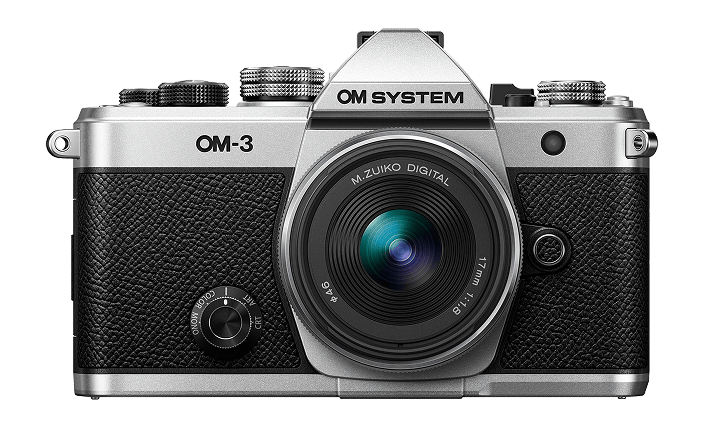
Today, I photograph with the OM-3. It delivers the same outstanding image quality as the flagship OM-1 while preserving the timeless design that first drew me to the system. Just as importantly, the Micro Four Thirds system allows me to carry several lenses without giving them a second thought. The lighter my equipment feels, the more completely I can lose myself in the rhythm of the street.
That's why OM SYSTEM has remained my primary system ever since.
The City Never Repeats Itself

The first time I travelled abroad was in 1992, when I visited Shanghai with a friend while I was still a student.
The city I encountered then feels almost unimaginable today. Shanghai was still developing, and its atmosphere reminded me of Japan in the years just after the war. Each time I returned, another layer of the city had disappeared, replaced by soaring towers, new roads, and an entirely different skyline.
Looking back, I realize that change had found its way into my photographs almost without my noticing.
Over the years walking cities with a camera, I've come to think of street photography as a quiet record of its time. Every photograph preserves something that has already slipped into the past.
Tokyo is no different. The familiar disappears with surprising speed. Redevelopment continually reshapes districts like Shibuya and the west side of Shinjuku. Stay away for a week, and the streets can already feel unfamiliar. Places you assume will always be there sometimes vanish before you notice they're gone.
Yet cities are changing even when buildings remain exactly where they were.
The light is never the same. The weather shifts. Different people cross the frame. One passing glance, one reflection in a window, one shadow stretching across the pavement... none of them will ever happen in quite the same way again.
That's what keeps drawing me back.
To me, the city has always been a kind of stage. The light is never the same, the weather is never the same, and neither are the people passing through it. Every scene exists only once, and every photograph is born from that fleeting moment.
That's why street photography never loses its fascination. As long as I'm able to keep walking, I'll keep photographing the streets and the fleeting moments they offer.
Photography by Takehiko Nakafuji
Written by Nahoko Ando
English translation by the OM SYSTEM team
Profile
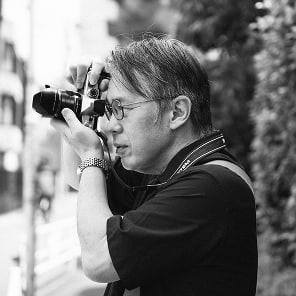
Takehiko Nakafuji
Japan
Takehiko Nakafuji (born in Tokyo in 1970) is a Japanese photographer whose monochrome street photography explores the changing character of cities and the passage of time.
After leaving university, he studied photography at Tokyo Visual Arts. Since then, he has exhibited widely in Japan and internationally, photographing cities across Eastern Europe, Russia, Cuba, France, the United States, Taiwan, and beyond.
His exhibitions at OM SYSTEM GALLERY include CHAOS SHIBUYA (2022) and LA & SF: THE SOUL OF THE WEST (2025). Recent projects have focused on major American cities and Taiwan, while also exploring the intersection of fashion and street photography.
Nakafuji received the Special Photographer Award at the 29th Higashikawa Awards and the 24th Hayashi Tadahiko Award. Alongside his own photographic practice, he is the director of Gallery Niepce in Tokyo, an independent gallery dedicated to contemporary photography.